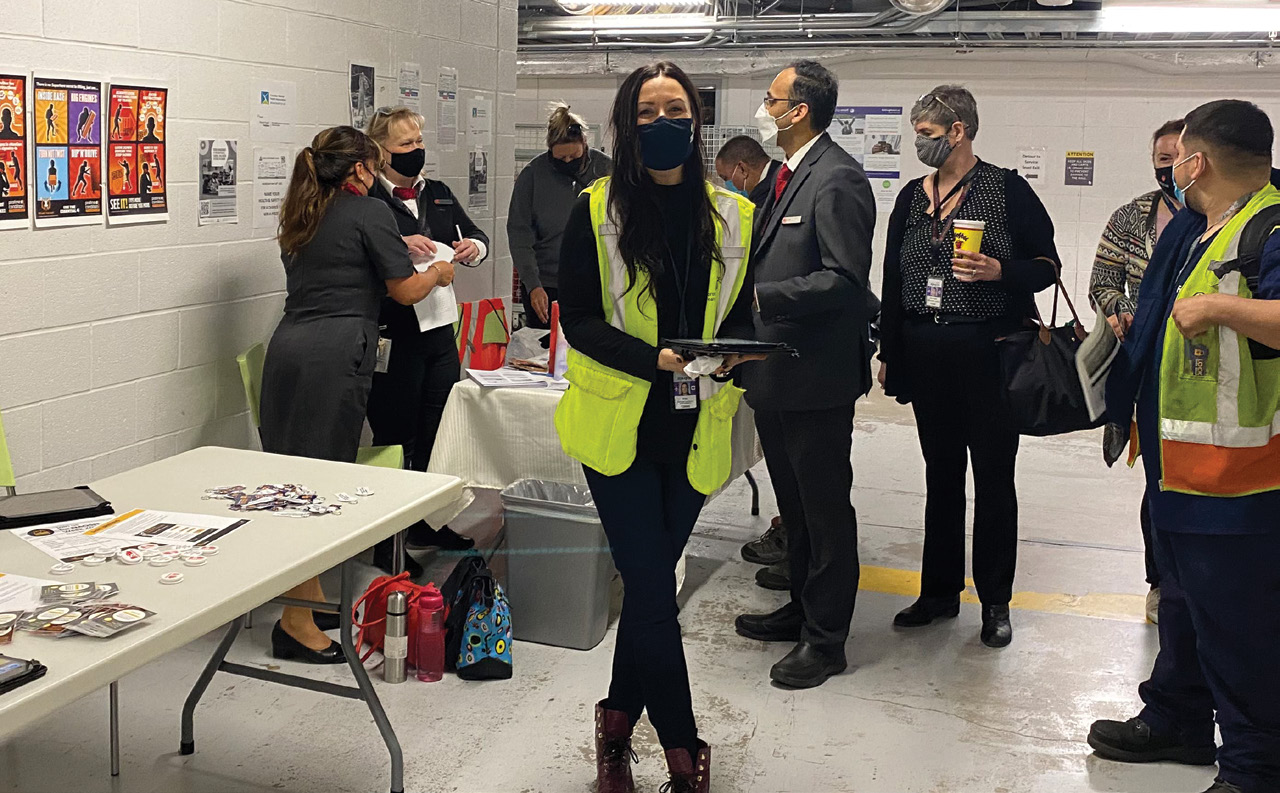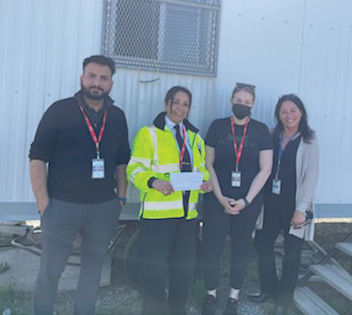
ASP Health and Safety participated in 2022 NAOSH week at Toronto Pearson International Airport from May 2- 6, 2022.
North American Occupational Safety and Health (NAOSH) Week
This year marks 25 years of bringing safety and health awareness to employers, employees, and the public. To celebrate, from May 2 to May 6, 2022, Airport employers shared tips and info on how we all can help keep our airport, passengers, and employees safe. Airport employees were also able to participate in online contests for a chance to win prizes!
Topics for the week
Monday: Day 1 – Airport Safety Programs
Tuesday: Day 2 – Reporting and Recognition
Wednesday: Day 3 – Emergency Planning and Preparedness
Thursday: Day 4 – Safe Movement of People, Planes and Passengers
Friday: Day 5 – Foreign Object Debris Safety
I look forward to seeing you at this event next year.
By Ivanna Skotar, Canine Handler
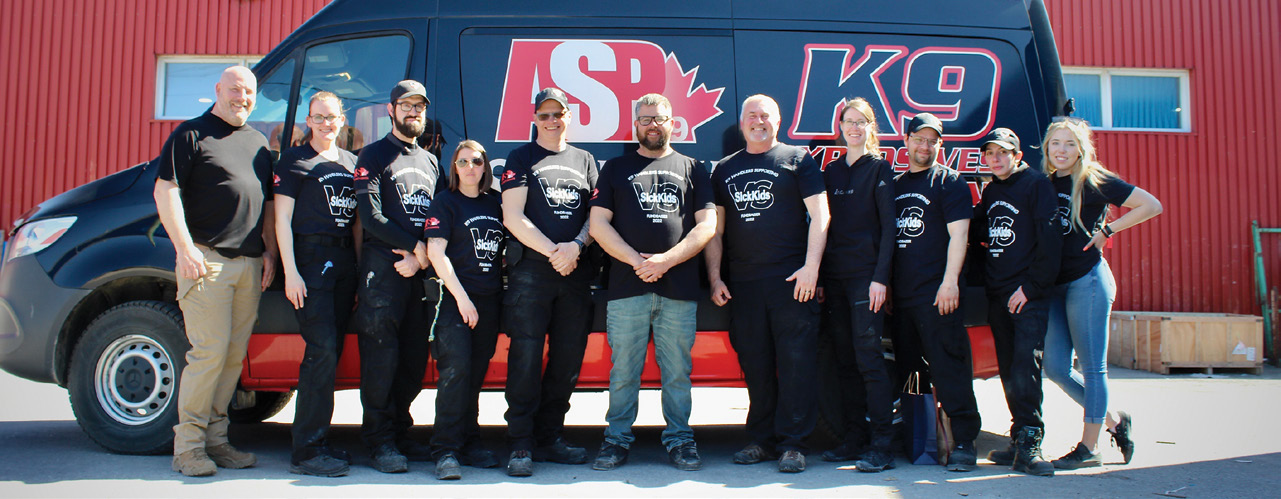
After several months of planning our first ever canine division fundraiser for Sick Kids Hospital in Toronto with teammates from across the country – we are proud to say we successfully surpassed our goal of $10,000 and we were able to raise OVER $11,000.
The Hospital for Sick Children is affiliated with the University of Toronto, and is Canada’s most research- intensive hospital and the largest center dedicated to improving children’s health in the country. Sick Kids creates ground-breaking clinical and scientific advancements and train the next generation of experts in child health. It holds dear to some of our handlers, as they’ve had medical treatments there themselves when they were young. With 27 registered participants/ handlers in our canine unit, it was a great success. The competition consisted of a 3-part challenge. The winner of the challenges was the canine and handler with the fastest time and highest amount of finds combined from all 3 events.
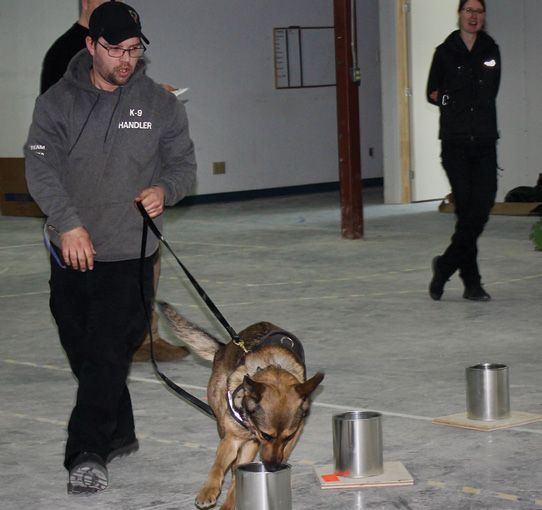
Event One consisted of 32 scent cans in 4 rows where there will be 3 target odors placed randomly intermingled with 29 distractor scents. The goal is to find the 3 as fast as possible.
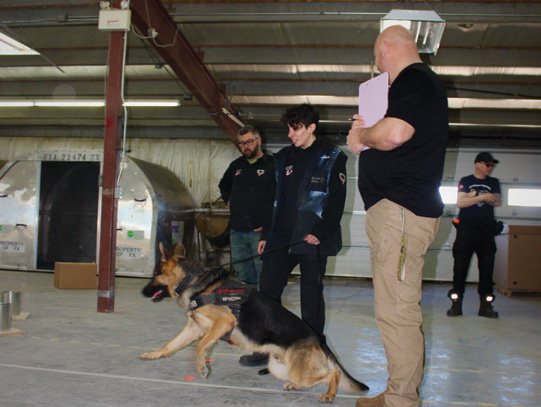
Event Two consisted of a specified measured enclosed area, where the handler must remain at the entry point and not assist the dog whatsoever in finding the single- placed hide. The handler had an option to do the search off-leash or with a long line. The timer ends when the handler successfully calls the dog’s indication.
Event Three was also an enclosed search area with an unknown amount of odors placed randomly throughout. The canine-handler team was given 4 minutes to find as many hides as possible. Teams were scored here on how many finds they found in the shortest amount of time.
Placing first overall, was handler Marc-Andre and canine Zora from Montreal, Quebec. With her lightning speed, it was hard to keep up with her. The second overall was handler Chris Brown with canine Sasha from Toronto, ON. Sasha’s great nose was precise and quick!
Very special thank you to our corporate sponsors – without you, this would not have been possible. From the bottom of our hearts, we’d like to thank AgapiK9, Omega Alpha Pharma, Olympus K9, and DJD Inc. We were also fortunate to have many other donors that contributed to our raffle and handler prizes. Another special thank you to our guest judges Karen Apfel, Yanick Choquette, and Jean-Marc Dugas across the provinces. We could not have done it without you!
An extreme amount of hard work and dedication went into this fundraiser. First, we’d like to thank our committee which consisted of 3 of our handlers across some of our provinces and our Master Trainer. Special shoutout to Paige MacDonald, Krista Hockey, Ivanna Skotar and Russ Fox for working tirelessly to put together an incredible fundraiser. We truly look forward to being just as successful next year, and hope to open it up to many others – including our entire ASP family.
Lastly, TRUST YOUR DOG, and we will see you all next year.
By Karl Katzur, Manager Operations
YSB was a beehive of activity through the month of May. The airport saw a marked increase in the number of daily flights from all airlines and a notable increase in passenger counts.
Throughout this busy period ASP also managed to increase its staffing levels with the addition of four new guard members. Thanks mainly to the efforts of Nadia Onorato and her recruitment team as well as Sarah Jessop and the HR team.
On Friday May 27, 2022, YSB opened the terminal to non-passengers and allowed family and friends into the airport for the first time in over two years. On Tuesday May 31, 2022, YSB conducted their mandated mock disaster exercise. A simulated airline crash and an active armed passenger were the focus of the exercise. ASP Security participated with a record attendance of seven guards and two supervisors.
Senior YSB staff reported that the ASP Security team carried out all emergency response procedures with a high degree of efficiency and professionalism. ASP security staff at YSB want to wish all management and staff a pleasant and safe summer season.
By Noman Butt, Client Manager
Supinder Khangura started with ASP on April 13, 2022. On May 4, 2022, Supinder was working at a post she had just been trained on, the construction gate, when she was met with by a GTAA Officer for Security Planning. The client had this to say about their interaction with Supinder:
“I attended the gates today and I was speaking to the guard at V313A. She was very knowledgeable and knew her post order very well. She smiled and told me that she loved her job, and it was very reassuring having her at this post. I think it’s good to recognize hardworking individuals.”
Supinder presents herself in a professional manner and she enjoys working for ASP at Toronto Pearson International Airport. We are incredibly proud of what she has achieved in such a short time.
By Daniel McCormack, Quality Assurance Coordinator
Hello ASP team! Summer has definitely arrived at YYC. The sun is shining, the breeze is sweet, and people are out and about! That means that they are out and about at the airport, and the ASP team here as busy as ever.
There is always an increase in traffic at this time of the year, which translates to an increase in security events. My security tip to all readers is to always be aware of your surroundings. Small things like staying on task and avoiding distractions while on post will ensure both your safety and the security of your area. Simple matters, like knowing how to enter and exit an area, can make a world of difference when you need to make quick decisions.
Additionally, the added traffic at YYC means increased interactions with the public. The team has hundreds of customer service interactions daily and the client is pleased that we go the extra mile on this front. It continues to demonstrate the quality and excellence of ASP. With the onboarding and training of over thirty new people in the past few weeks, we must continue rolling up our sleeves to bring our new recruits up to speed. They are all excited to get to the post and make the most of their time with ASP. I know that the group here is dedicated to their success — everyone can remember being new! This increase in new hires points to some very positive things for ASP, like the return of some of our access control positions in the future.
Good luck to our newest family members. Remember, there is no rush when it comes to performing security the right way!
ASP continues to gain confidence from the YYC community. There are exciting opportunities in store for this team if we continue to pull together and show off our skills. I’m confident that everyone will help realize that goal.
Until next time, ASP, take care out there!
By Eryn Henry, Senior Workforce Scheduling Manager
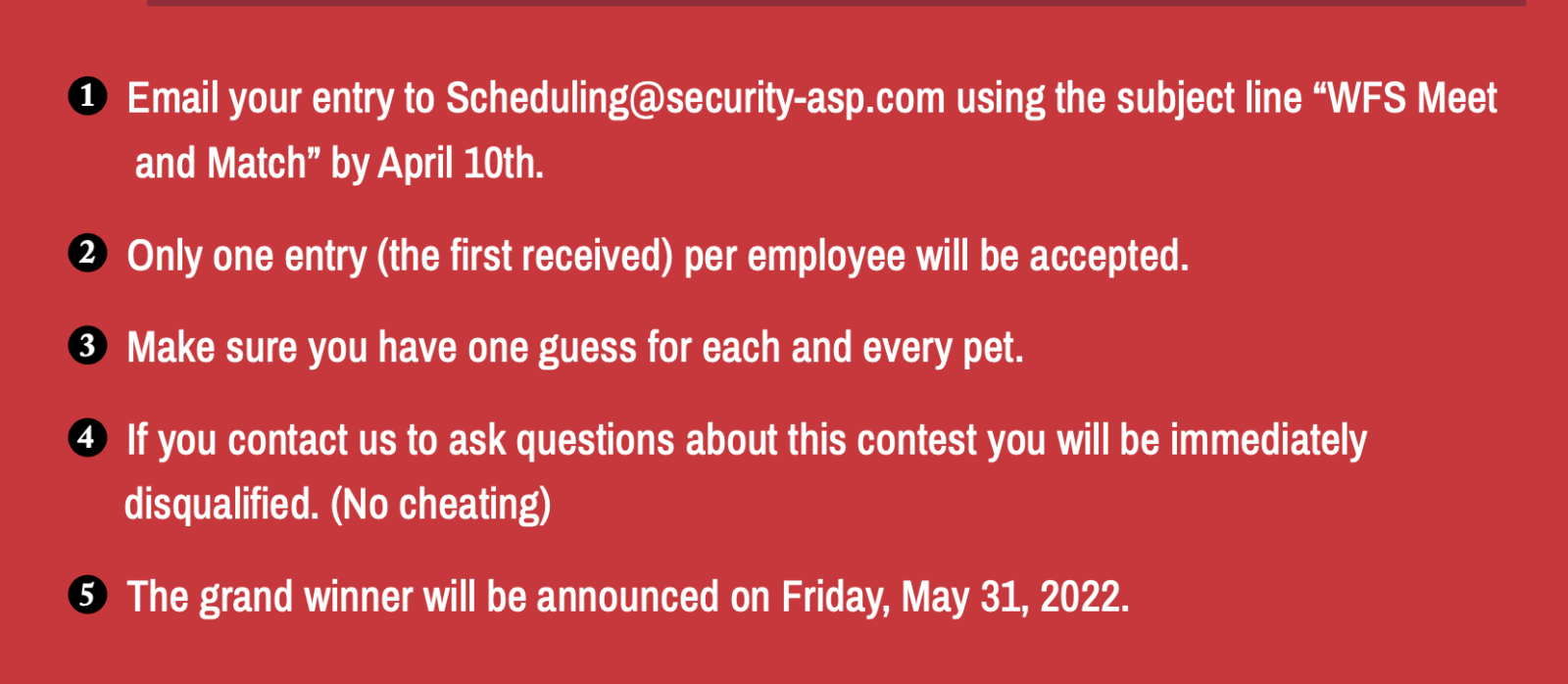
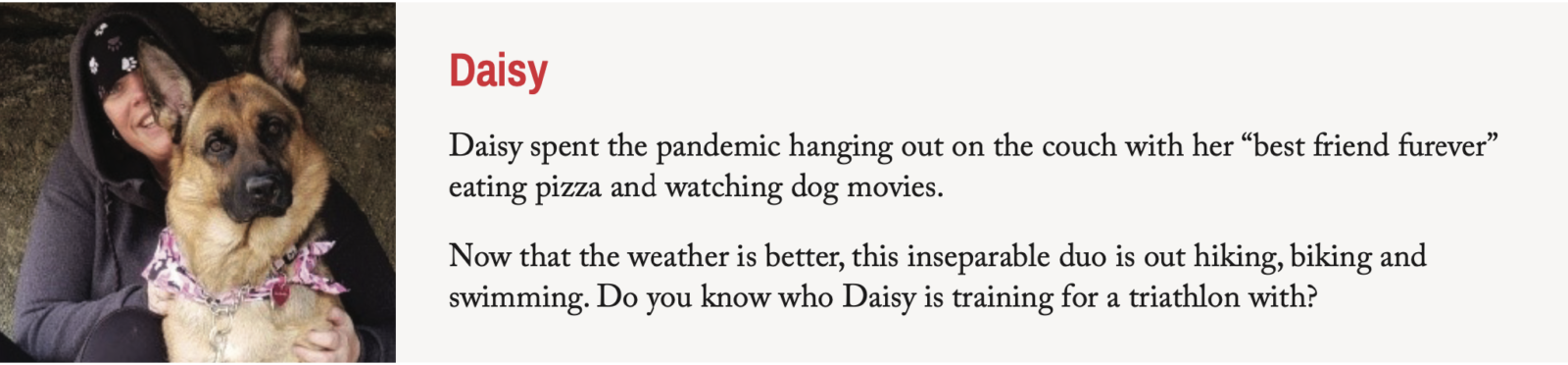
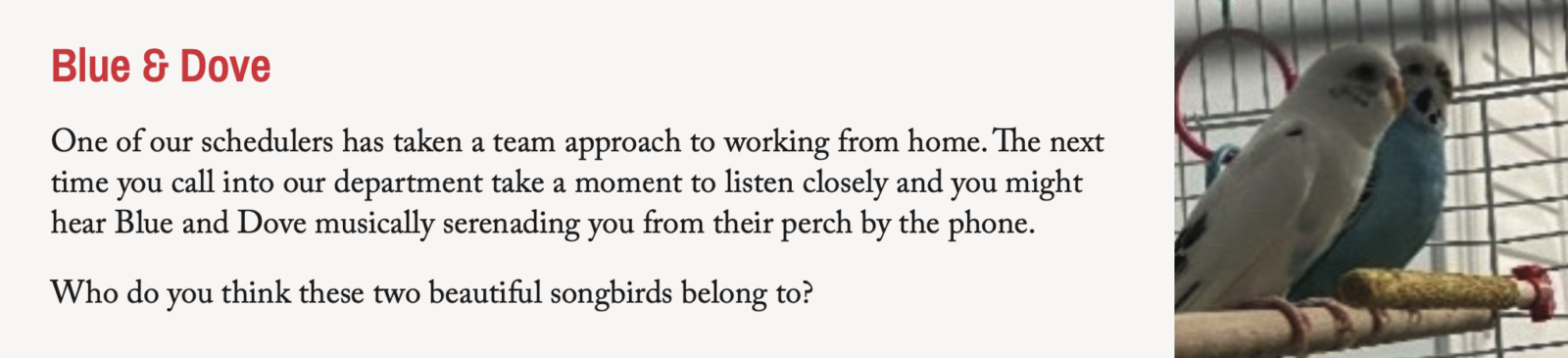
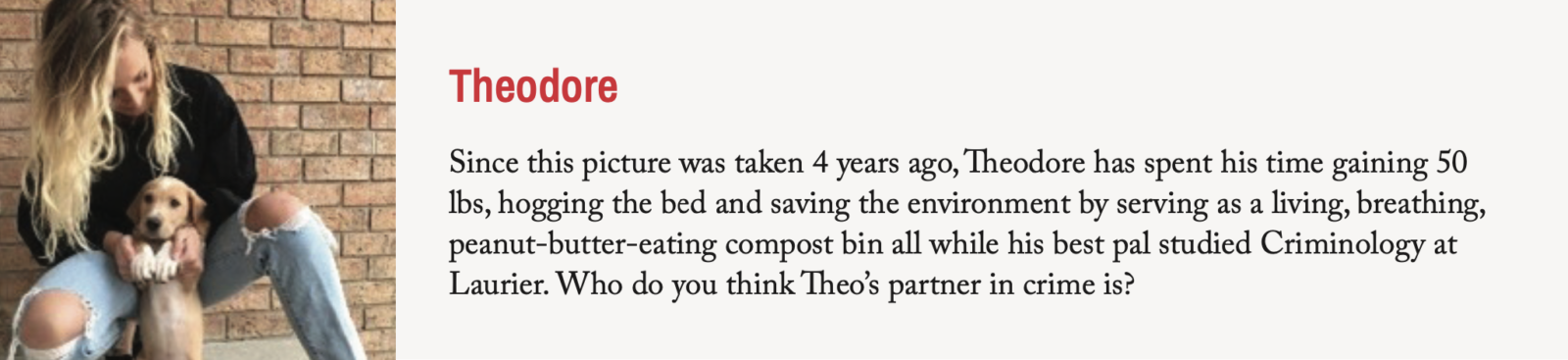
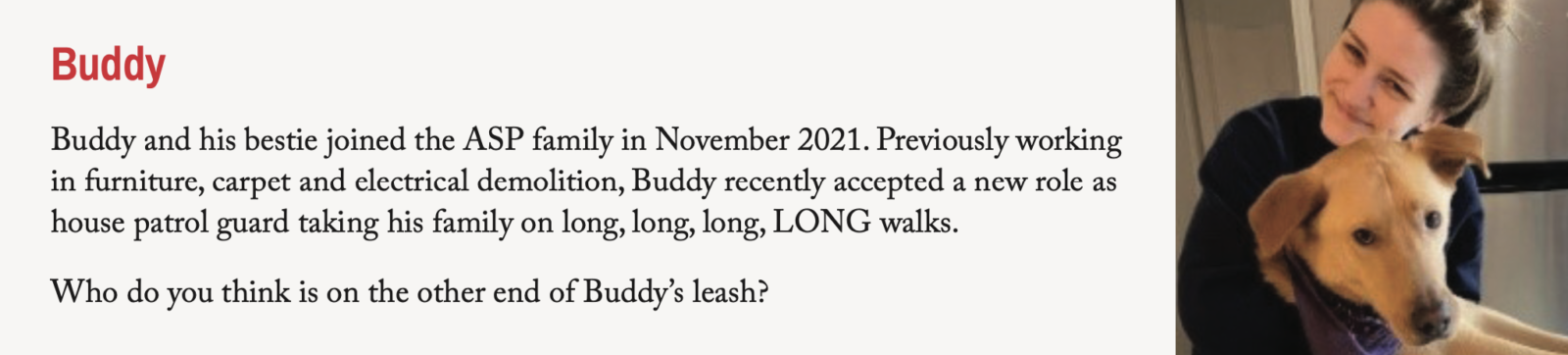
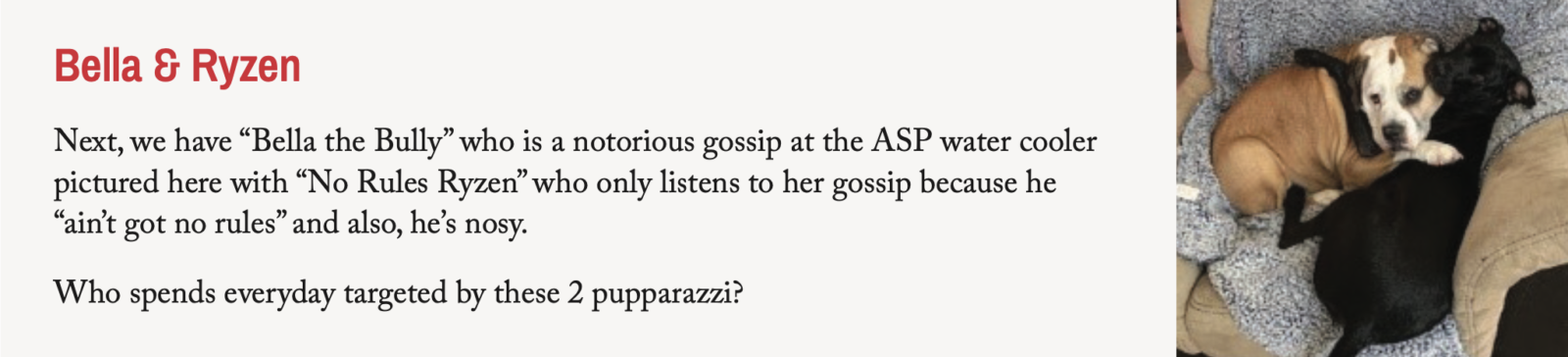
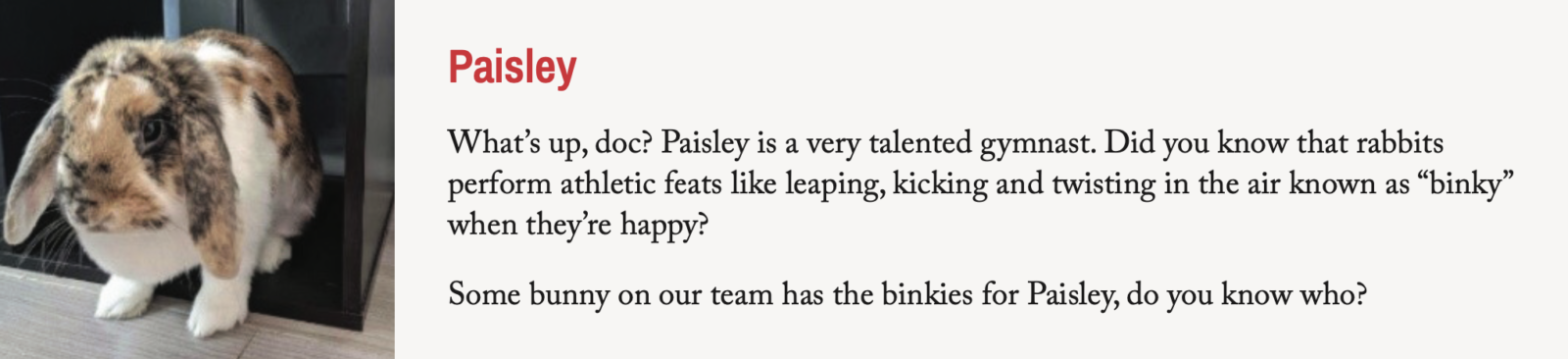
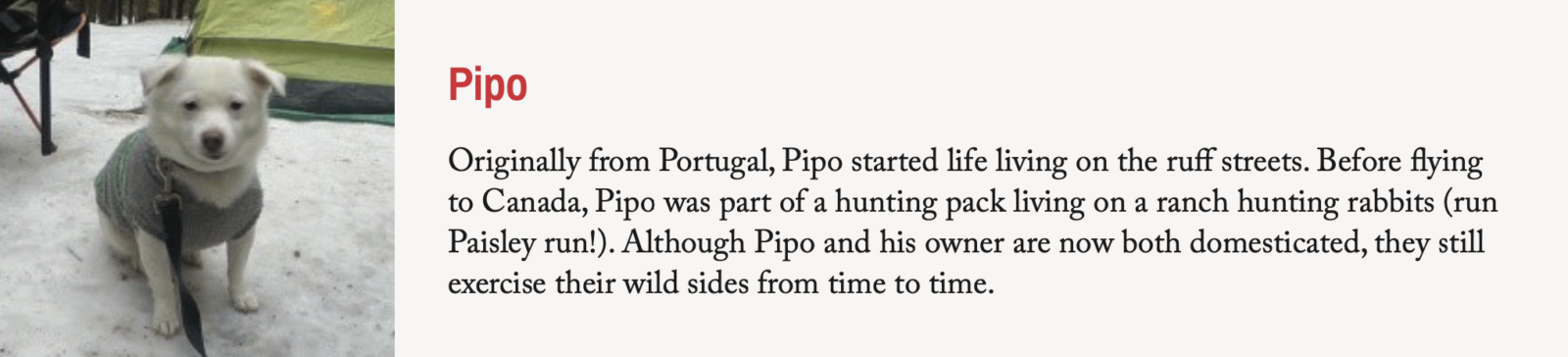
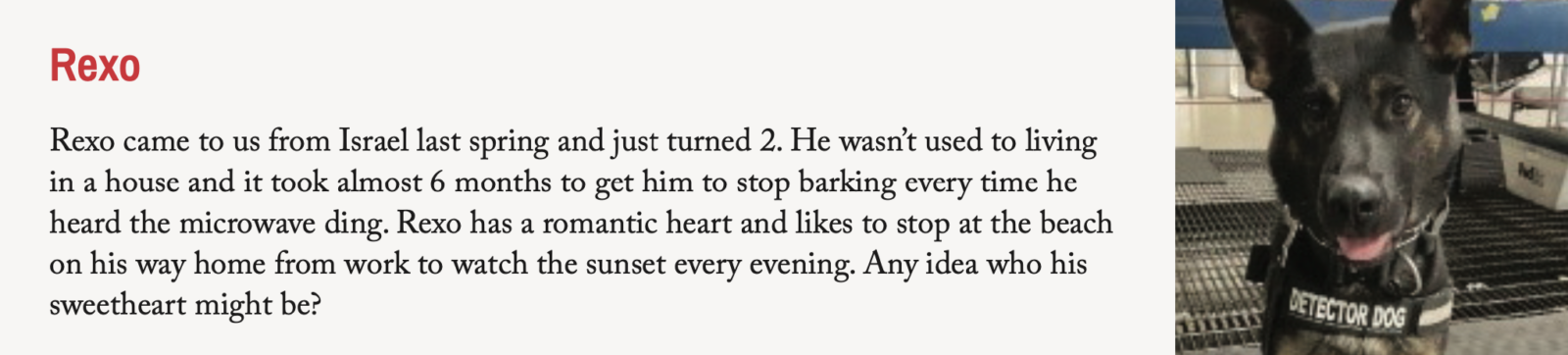
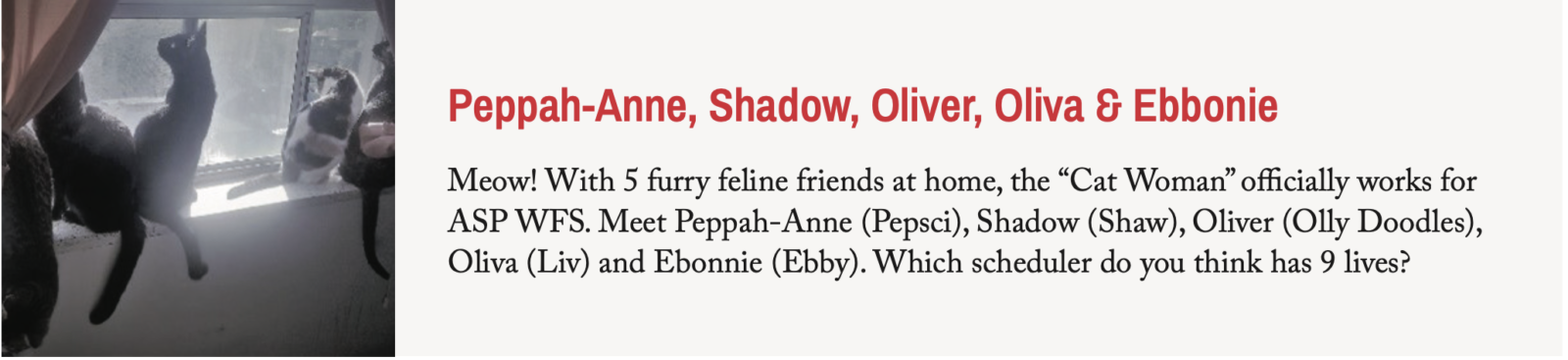
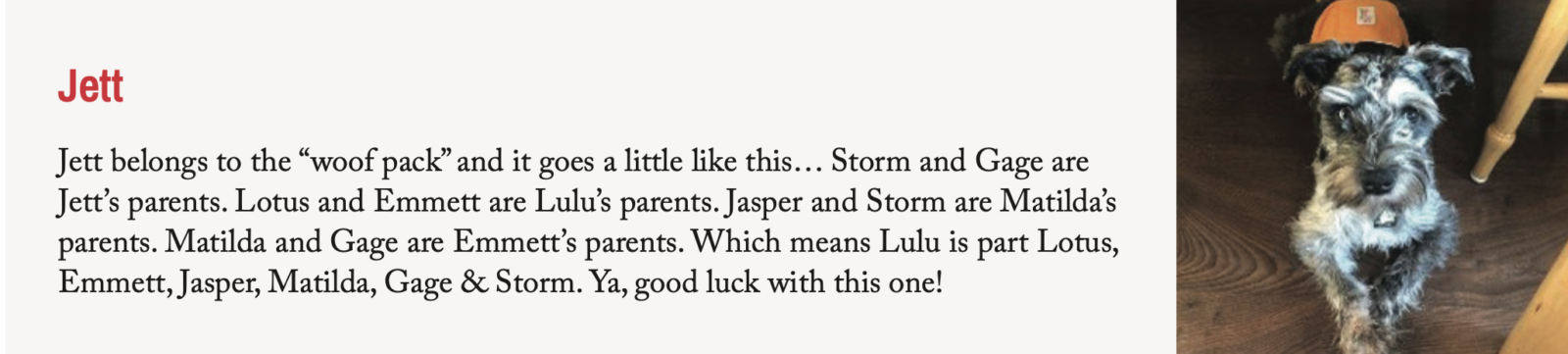
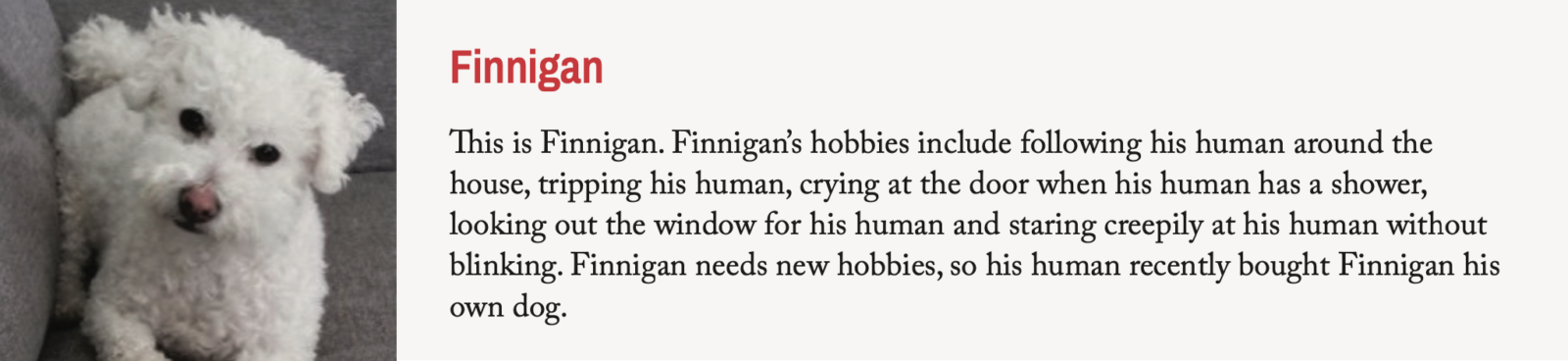
Meet the ASP Workforce Scheduling (WFS) team by meeting some of our pets! Below you will find pictures and bios of pets that belong to schedulers: Bill, Alanna, Jamie, Cassandra, Eryn, Hardeep, Preet, Stephanie, Jaime, Brennan, Gwen and Tamara. Read the bio and match each pet to their owner to win a $50 Tim Horton’s card so you can buy coffee for your team on behalf of our team! Make sure you follow the rules below to qualify:
By Laurel Woodhouse, Health and Safety Manager
Psychological resilience can be defined as the ability to resist and manage stressors and to “bounce back” from stressful life events. It is vital to understand that resilience doesn’t mean being strong all the time, and never experiencing stress.
Resilience is often the ability to be aware of the psychological impact that stressors are having on you, and consciously engaging in activities that help you manage and cope with them.
The pandemic has been a test for resilience for people all over the world. It has stretched everyone’s inner and outer resources, leaving people to adapt to circumstances that were unprecedented.
Although external circumstances have felt out of control for a while, it does not mean that you cannot take control of your inner circumstances. Here are some tips to remain psychologically resilient, despite what is going on in the world:
Tip 1: Maintain a Social Support Network
It is much easier to be resilient to the challenges of work and life if you have a solid social support network. Talking about your feelings and having strong connections to a partner, family, friends, or work colleagues helps you to be more effective at facing life’s difficulties. It is important to make time for these contacts, and it is vital to keep being social even when you feel under pressure and you may not feel like it. This has been particularly important during times of lockdown or self-isolation. Technology has made it possible to maintain connections, even when we feel isolated.
Tip 2: Maintain a Third Place
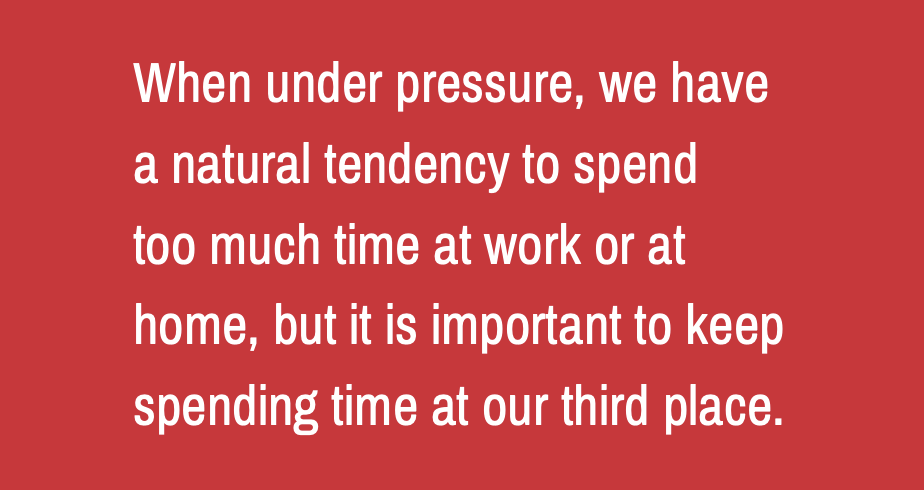
An important element of being resilient is to have a “third place”. This third place should be in addition to your home (first place) and your workplace (second place). Your third place should be a physical environment where you go to relax, socialize, and/or engage in an interest/hobby. Examples of third places are health clubs/ gyms, sports clubs, coffeeshops, and so on. If you are still under lockdown restrictions your “third place” may be somewhere in nature, or a special place in your home. The location doesn’t matter, as long as you can relax and de-stress here.
Tip 3: Thinking of Others
It has often been noted that people who perform voluntary work are more resilient than those who do not engage in such an activity. This is because by engaging in voluntary work, an individual has thought about what is important to them, and then spends some time on this activity without monetary reward. It is not necessary for you to engage in voluntary work (although you may decide to do this) but thinking about what activities are important to you, and to spending some time engaging in these activities builds resilience. The pandemic showed how desperately people needed each other for support, shopping for essentials, or simply to exchange a small “hello”. What ways did you reach out to help another, or what ways would you like to, moving forward?
Tip 4: Keep a Boundary Between Your Personal & Work Life
Pressures and problems can come from both your personal and work life. One key strategy to be resilient from pressures is to keep a clear boundary between your work and personal life. You need to have techniques for “switching off ” from work so that it does not impinge on your personal life. There are a variety of methods for this; for example stopping for a coffee after leaving work before going home. Don’t forget, it’s also important to not let personal problems have an impact on work. This became a challenge throughout the pandemic as many people were forced to work from home, and the boundary between work and home became blurred.
Tip 5: Know Your Early Signs of Stress
Resilience is not about being strong all the time and never feeling pressure or stress, it’s about knowing when you are starting to feel stressed and using techniques to help keep in control e.g. deep breathing, exercising more, and talking to family and friends about how you are feeling. To help with this it is useful to be aware of what your early signs of stress are. Early signs tend to occur in four areas:
Physical
Generally, more people have some physical signs when they are starting to feel stressed. This can be headaches, pain in the neck/shoulders or digestion problems.
Emotional
When under stress, people can feel angry, frustrated and/ or low in mood.
Cognitive
When under pressure, we tend not to think effectively so we can become indecisive, or we become more forgetful or experience concentration difficulties.
Behaviour
Behaviour can change; we can lose our temper more frequently or have trouble sleeping.
Tip 6: Physical Exercise
As a rule, the healthier you are physically, the easier it is to be resilient to stressors. One important way of maintaining your resilience is to be active, focusing in particular on cardiovascular exercises and body stretches. The key is to do some exercise little and often, for example walking, swimming, cycling, or playing sports. It is very important to maintain an exercise regime when you are feeling particularly stressed, and if possible to do slightly more exercise than usual to help you cope with the difficulties. This is especially true when working from home, or feeling stuck in the same place for long periods.
Tip 7: Deep Breathing
Deep breathing is one of the easiest relaxation techniques to master, and it is also one of the most effective in helping you remain calm and resilient. Slow, deep (diaphragmatic) breathing slows down your heart rate, lowers blood pressure and reduces tension in the muscles. The simplest method for practising deep breathing is as follows:
Sit comfortably in a chair with good posture, and both feet flat on the floor. Close your eyes and place your left palm on your stomach and your right palm on your chest. Now breathe slowly in through the nose, and out through the nose without holding your breath at any point.
Try and expand your stomach as you breathe in and contract your stomach as you breathe out. Try to breathe so that only your left palm moves and not your right. Your chest and shoulders should not move as you breathe, only your stomach. All the time you should be relaxed and concentrating on breathing slowly.
Tip 8: Reduce Self-Criticism
One habit many people have which, reduces their resilience, is that they are too critical of themselves. Self- criticism often occurs as a voice in our head (sometimes called an internal monologue) which is critical of our thoughts, feelings, and behaviour. Something that is often linked to self-criticism is our tendency to be too critical of others. One method to help us be less self-critical, and therefore more resilient, is to consciously try to become less critical and negative towards others.
Tip 9: Personal Organizational System
Increasingly in modern life we have a multitude of activities and tasks to keep track of—both at work and in our personal life. Managing all these tasks can be stressful. So, to be resilient, it is important to have an organizational system that prevents us feeling overwhelmed by the demands placed upon us. Specifically, your organizational system should achieve two major elements which help you maintain your resilience: Keep your to-dos “outside of your head”. In other words, you should not rely on your memory to trigger when you should do your actions, it is your organizational system that reminds you when to do things. The less you rely on your memory, the better. It is always vital to have a clear distinction between tasks which are urgent (that is time dependent and must be performed now, such as answering a ringing phone) and those which are important but can be dealt with at your own pace. Resilient people tend to spend more time on actions which are not urgent but are important. When we are under pressure and stressed, we tend to focus on the urgent, unimportant tasks.
Tip 10: Resilient Thinking
A vital element of being resilient is how you perceive and think about the challenges that life throws at you. Resilient individuals tend to be good at keeping stressors in perspective so that they are not overwhelmed by such stressors. Equally, resilient individuals focus on how they can solve their problems or make their problems easier in some way.
Resilient thinking tries to be as creative as possible and to focus on solution and/or management of a problem not on the problem itself and the feelings it generates. The analogy of resilient thinking that is often used is: “When you have fallen into a hole, your thinking should be how do you climb out of the hole—not how you fell into the hole, or how unlucky you are to be in the hole.”
A very useful technique for maintaining resilient thinking is to keep a Gratitude Journal. Every day, you should write in this diary three things in your life that you are grateful for. The key is that every day you should come up with three new things to be grateful for. By carrying out this activity you are training your mind to focus on positive things which in turn helps you be more resilient.
In your busy life, it may not be possible to implement all of these tips, but always try to think creatively and it may be possible to combine two or more tips together e.g., playing tennis with your partner and/or children. This will enable you to maintain your social support network, spend time on an activity which is important to you—and it will give you some exercise.
Displaying or circulating offensive pictures or materials in print or electronic form
Repeating offensive or intimidating phone calls or inappropriate advances, suggestions or requests
Providing only demeaning or trivial tasks in place of normal job duties
Undermining a worker’s efforts by setting impossible goals, with short deadlines and deliberately withholding information that would enable a person to do their job
Sabotaging someone else’s work
What is NOT Considered Workplace Harassment?
Reasonable action or conduct by an employer, manager or supervisor that is part of his or her normal work function would not normally be considered workplace harassment.
Examples include:
Changes in work assignment or schedule
Measures to correct performance deficiencies
Imposing discipline for workplace infractions
Requesting medical documents in support of an absence from work
Enforcement of dress code
Difference of opinion or minor disagreements between co-workers would also not generally be considered workplace harassment
How to Report?
Reporting How to Bring Forward Concerns/Complaints under this Policy
Employees can contact a Manager, Supervisor, Lead, Site Supervisor, Patrol Supervisor, or Human Resources representative
If the employee’s complaint is against their own supervisor or manager, then they may escalate their complaint directly to Human Resources
This procedure applies even where employees believe that someone not employed by ASP is in violation of this policy
Reporting Concerns and/or Complaints
A claim of a breach of this Policy may be made by an employee in writing or verbally.
Management to Notify Human Resources through ASP’s incident reporting system (i-sight) If a manager receives a complaint or becomes aware that a person in the workplace may have acted contrary to this Policy, the manager must promptly report the complaint or incident to Human Resources.
Note: If the allegations are against Human Resources, the manager can escalate the complaint as appropriate (i.e., report to the department head).
Investigation
Any reported allegations of harassment, violence, discrimination, or reprisal will be investigated fairly, promptly, thoroughly, and impartially by the Human Resources department or another appropriate party.
The investigator will interview the complainant, the respondent, all potential witnesses (where possible) and any other individual who the investigator deems to be relevant to the complaint.
Upon completion of the investigation, the complainant and respondent will be informed of the results of the investigation.
If the complaint is substantiated, persons found to have engaged in a violation of this Policy will be issued appropriate disciplinary action up to and including termination of employment for cause.
If the investigation reveals that an individual has brought a concern forward in bad faith, the individual may be subject to discipline, up to and including dismissal for cause.
Confidentiality All records of the investigation will be kept confidential. The investigation documents, including this report should not be disclosed unless necessary to investigate an incident or complaint of workplace harassment or violence, take corrective action or otherwise as required by law.
By Russ Fox, Master Trainer
ASP Canine division is so fortunate to have such a diverse and talented group of members involved in a variety of activities and private ventures.
Every handler brings their own experiences and expertise with them, benefiting all of us here.
I would like to focus on one of our members in this article, Anne-Marie Paré, who is currently handling EDD Ylva and is based out of Quebec City. Anne-Marie is very active in the dog sport world where she competes and trains both in IGP dog sport as well as another sport called “Canicross”.
For those of you that have not heard of Canicross, it is basically a cross country race conducted with your dog. The competitors are connected by bungee cord to their dogs’ harness, and then they run a timed course. The course can range anywhere from 2km to 15km, but usually falls into the 4-5 km distance.
Although the sport is popular in Europe it is relatively new to Canada and was officially introduced in Quebec in 2006. Since then, it has steadily grown. The sport is recognized by an international Dog Sport organization (FMBB) which organizes dozens of dog sports and 1000’s of competitors.
Anne-Marie has been involved in CaniCross for the past 7 years. She has quickly risen to the top of this sport, first qualifying for the world championships in 2020 with her first dog Zimbabwe. Then, along came COVID and a serious car accident, side lining Anne-Marie with 4 cracked vertebrae.
After a lengthy recovery with physio, Anne-Marie trained for a comeback and has become Canada’s first representative for the FMBB World championships to be held in Greece in May.
Anne-Marie and her running partner, 2-year-old Belgium Teverun “Jigsaw,” will compete over 2 days, running a 2km course on the first day and a 5 km race on the second day.
By Karl Katzur, Site Security Manager
The snow is melting in Northern Ontario, and we are all looking forward to summer. The Sudbury airport is seeing more passengers. As well, the Porter Airlines deal with Air Transat promises better connections to points eastward and beyond for YSB passengers in 2022. It is an exciting time for the airport.
ASP Highlights at the Sudbury Airport Include:
• We played a major role in assisting the client with completing a formal RAIC Audit for Transport Canada. ASP plays an integral role administrating the YSB Pass Office.
• Five new guards have been onboarded to fill open roles left by two guards leaving ASP and one guard stepping back from full time to casual hours.
• A new testing and audit program is being implemented to keep all guards current with the clients Post Orders and Standard Operating Procedures.
• The guards requested moving to continental shifts at YSB to achieve more meaningful time off and better manage open shifts. This was implemented in late fall of 2021 and the satisfaction rate is high and has also allowed overtime rates in excess of 30% to be reduced to below 3%.