By Paul Parkinson, Director, Finance

Numbers guide behaviors. Just as your bank account balance influences your spending habits, careful monitoring of your key health metrics can help you make better decisions about your health.

When your numbers fall outside the recommended target ranges, you are more likely to bemotivated to take actions that help reduce your risks for developing chronic health conditions, like diabetes, hypertension, and heart disease.

For that reason, knowing your numbers is the first step toward better health. Here are some health numbers youshould know and why.

Blood Pressure

Higher than normal blood pressure values are associated with a higher risk for chronic health conditions, like stroke and dementia. Regularly monitoring can help alert you to take immediate action and seek guidance from your doctor.

Cholesterol

Elevated lipids place added strain on your cardiovascular system, so if your numbers have been creeping up over time, it may be helpful to take a closer look at your eating and exercise habits.

Blood Sugar

High blood sugar (sometimes called glucose) may indicate that your body is not managing or using insulin properly. Periodic monitoring of your blood sugar values can help you make better decisions about your daily choices.


By Rachel Raposo, Service Delivery Manager, Residential and Commercial Division

Avtar Bhamra

An employee’s motivation is a direct result of the sum of interactions with his or her manager.–Bob Nelson

Avtarhas worked with ASPfor oneyearandsixmonths. He has been a guard at our TTCgatehousefrom the start.Avtarhas transitionedinto our Respite contract,as he is looking to advance his career into Corrections. He has shown he is able to adapt to change effortlessly and has a can-do attitude. Thank you,Avtar, for your continued service at ASP!

Karen Swanston

Take time to appreciate employees and they will reciprocate in a thousand ways.–Simon Sinek

Karen is our administrator, whowas a crossing guard for ASP Karen, to me is kind of like a utility player in baseball… always ready to support the divisions. As the school year kicked off, she has provided great support to the Crossing Guard groupduring start-up,all the while learning RES/CICdivision as growth continues. I have known Karen for two months and I see that she shows great pride in her work and always brings a smile to the workplace. Thank you fromall of us at ASPKaren. Keep up the great work!

How does ASPmake you feel valued as an employee? I go home and know the work I did that day matters our clients and to my team. Fun fact:She has retired 3 times


By John Gangasingh, Operations Manager, Residential and Commercial Division

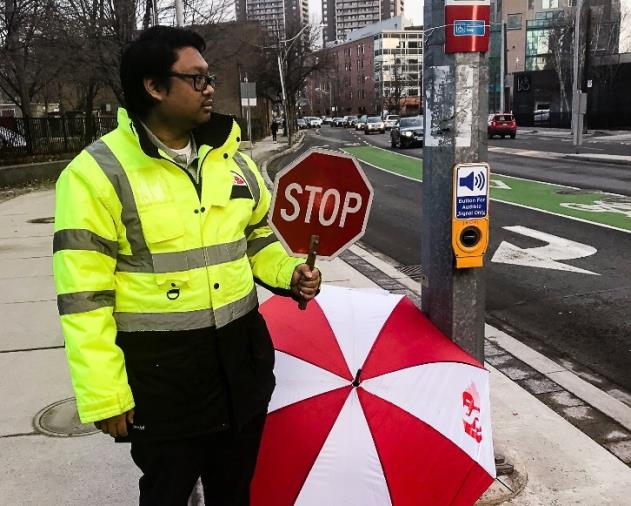
As the school year resumed, so did our School Crossing Guard Services Contract with the City of Toronto.

With no surprise, there were some anticipated challenges prior to start-up due to the infamous global pandemic, COVID-19. Our teamand extended support from other divisions putinmany extra hours daily and on weekends to ensure we would be as ready as possible.

We developed weekly town halls in-class and virtually to support social/physical distancing, we sourced out all the necessary Personal Protective Equipment, we re-vamped schedules, updated our Xguard APP, while, all along, maintaining an open line of communication with our client for full transparency.

The resumption of full services officially started on September 14th, 2020. Even with some last-minute obstacles, the team pulled together once again and we completed the first start day with no open shifts and a full complement of staff.

It is times like these that I truly take pride in having such an amazing team and working for such a wonderful organization. I’d like to personally thank and recognize a few team members that we just would not have succeeded without.

  • First, our Recruiter, Alyssa Rizzo, who managed to hire, not only the initial allotment of crossing guards needed, but approximately another 40 within just a few days before start-up. I don’t know how she pulled it off, but she may now be known as Alyssa “The Magician”!
  • Secondly, our Employee Development team. Between Training Coordinator Mike Moledzki and National Employee Development Manager Bryan Joly managing to onboard all new crossing guards through extra training classes, weekends, etc., we just would not be ready to go without them.
  • Lastly, both our Administrators, Tamana Bhatia/Karen Swanston and our Service Delivery Manager, Asad Abbas. These three worked collaboratively every day for the last few months ensuring everything is tracked, followed-up on, and delivered in a timely fashion from all aspects of the Operation and administratively. They are the face of the Crossing Guard Services Contract amongst the frontline team and I could not be happier about that.

I am very proud and grateful to lead such a wonderful team. I look forward to a strong remaining school year of keeping our students and each other safe. Keep up the great work, everyone!


By Sean Gallagher, HR Recruitment Manager

Precautions to Prevent the Spread of COVID-19

With COVID-19 in effect for the past six months, a lot has changed in the world, including how our company must recruit.

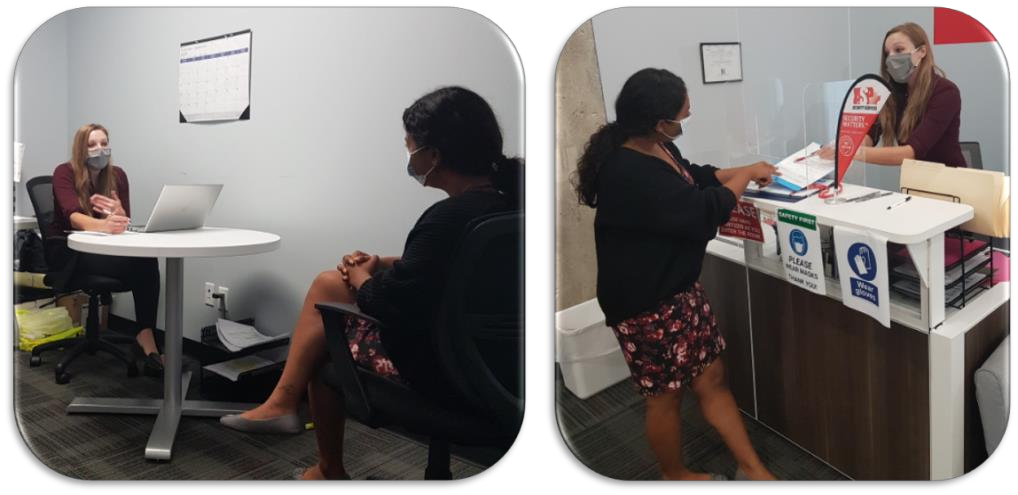
We have worked effectively and efficiently to create a safe and sanitary process for recruiting and interviewing not only for the candidate but the recruiter as well.

Here are a few of the processes we have been following:

  • Video Interviewing.
  • Face to face interviews with masks on and 6-10 feet between interviewer and interviewee.
  • Sanitizing the chairs and tables in the interview rooms.
  • Candidates fill out a COVID release form, use hand sanitizer and put latex gloves on before the interview.

Referral Bonus

We are introducing a referral bonus company-wide for all security, customer service, crossing guard and office positions.

If you know someone who would make a great fit in our company, please have them apply at www.security-asp.com and make sure they mention you as a referral on the site.

For you to be eligible for a $100 bonus per referral, they must:

  • Be hired on with A.S.P. Incorporated.
  • They must mention you as a referral either at the interview or on the application.
  • Work a minimum of 2-3 shifts weekly.
  • Stay with ASP for 3 months or longer.

Once they pass probation, you will receive your bonus electronically from our payroll department. If you have any questions about this, please do not hesitate to contact Sean Gallagher at sgallagher@security-asp.com.


Video Interviewing Etiquette

When video interviewing for an internal posting, please keep in mind:

  • Dress as if you were going for a formal in-person interview (do not underdress).
  • Make sure the Video Interview forum (Zoom, Microsoft Teams or Skype) works by signing on 10-15 minutes early.
  • Be seated at a desk or table and not walking around or driving.
  • Keep the background “glare-free” and keep clear of background objects and noises.
  • Speak clearly and take your time answering questions.
  • Make sure your WI-FI connection is excellent sothere isno lag in conversation.

Example of what not to do in an interview:

We conducted an interview right after COVID 19 closures started and had a candidate accept a date and time. Our recruiter called into the meeting, and the candidate answered while driving. They placed the phone in the cup holder and wanted to continue the interview. The candidate didn’t have an option to keep eye contact or elaborate on questions because they were too busy watching the road.

To make things worse, the candidate decided to ask the recruiter to wait a moment while she pulled through a Tim Horton’s drive-thru window to get a coffee. The candidate left the volume and video running while she ordered. The process took around 4-5 minutes, and the recruiter also witnessed the candidate being rude to the drive-thru window attendant. Once the candidate came back, the recruiter ended the interview and decided not to move forward with them.

The point to this story is that if you are truly interested in a position, please follow the above steps and always be positive and professional.


By Petra Nash, Executive Assistant

Social media such as Twitter, Facebook and Instagram, have become a primary source of information recently.

During a crisis like the COVID-19 pandemic, employees, customers and clients turn to social media to get information from an organization. It is during these times, that providing clear concise information makes the world of a difference in your organization.

Never have we had more real-time information available in the face of a worldwide event. Such information can help keep us safe, providing us with a better understanding of what is occurring and how it might impact us and those we love..

ASP during this time has been active on many social media platforms, providing our employees with updated information. We have been posting on our COVID-19 dedicated website page, YouTube Channel, Twitter, Instagram and Facebook.

Keep checking our social media platforms for more information as it becomes available. If you have any questions, you can submit them using the link https://www.security-asp.com/covid-19-faqs/.

You can also review all of our past memos to employees as well as communication from the President and CEO.


By Paul Parkinson, Director, Finance

Have you moved, or had some other change in your life?

With the COVID-19 impact to the operations, the office has seen an increase in the number of mailings going out. It’s important that we have your correct address and contact information on hand. This will ensure that any correspondence reaches you in a timely manner.

We do not want you to miss out on important news, payroll documents, or even shifts. An easy way to check to see if your address is correct is to check the address listed on your paystub. If this is incorrect, then send an email to asphr@security-asp.com and we will be sure to update our systems accordingly. Any new address, phone number or emergency contact information should be sent through to us to update. This is often overlooked item in our very busy lives.

Are you missing hours on your paystub? We have many employees and our business is anything but normal. We’ll admit that we’re not perfect but strive for perfection. At times, we could have missed hours on the paycheque. You can help us. Our scheduling software has an employee portal which allows you to check your schedule and the hours worked.

If you see something that is missed, such as your shift being extended, get a note off to your supervisor for correction before the pay period closes. In doing so, you ensure that you have the right number of hours being paid when you receive the paystub and lessen the impact on everyone.


By Deborah (Debbie) Ciccotelli, Vice President, Strategic Initiatives

On behalf of the senior leadership team, I am delighted to introduce Vince Bozzo, our new Senior Director of Operations in the Aviation Division.

Vince is responsible for the oversight and management of all Aviation Customer Service contracts, including Toronto Pearson OSR, Ottawa and BBTCA/Nieuport Customer

Service, as well as the Commercial Canine Unit and the Resource Planning Department.

Prior to joining ASP, Vince was the General Manager, Head of Venue Operations for Maple Leaf Sports and Entertainment (MLSE). Vince has over 20 years’ experience in operations, customer/client service and security. His extensive experience combined with his open, people first management style and collaborative customer centric approach is indicative that he is ideally suited to the ASP culture.

Prior to joining ASP, Vince was the General Manager, Head of Venue Operations for Maple Leaf Sports and Entertainment (MLSE). Vince has over 20 years’ experience in operations, customer/client service and security. His extensive experience combined with his open, people first management style and collaborative customer centric approach is indicative that he is ideally suited to the ASP culture.


By Vince Bozzo, Senior Director of Operations, Aviation Division

I want to thank everyone for welcoming me to the ASP Family on June 1st. In my short time here, I have been welcomed by an extraordinary group of leaders and employees that exhibit a strong belief in teamwork.

I am excited to work with each of you to continue to see ASP grow and deliver exceptional service to our clients.

For over 20 years, ASP has been what I would call a winning organization, one that prides itself on a culture of integrity, accountability and transparency with our partners and clients as well as our teams. These pillars of success are grounded in strong communication, steadfast training, exceptional service and most importantly the strength and dedication of the people that are part of the team.

As ASP grew over the last 20 years into the strong team they are today, I had the privilege of working for Maple Leaf Sports & Entertainment Ltd. (MLSE), as their Head of Venue Operations. For over 22 years, I learned the value of strong and genuine leadership and the utmost importance of a talented group of people in delivering exceptional service.

As mentioned, the first pillar of success is strong leadership. ASP is extremely fortunate to have excellent leaders working together to build a strong team. I joined ASP during an unprecedented time in the world and I have witnessed a group of people working resolutely together to plan, respond and develop critical strategies for our organization. Like many companies, ASP has had to adjust and reforecast as the world continues to learn and adapt to an extraordinary situation. These leaders have been planning for our staff during this pandemic while always thinking of the future and making sure we are ready to come out of this stronger than ever!

A second pillar that has helped ASP survive and succeed in this unprecedented time has been all of you. An organization will only succeed with leaders who believe in developing a strong team. We are lucky to work with talented individuals that share the same beliefs and are committed to ASP Although times have been very tough for each of you, I believe that with our shared dedication and commitment to ASP, we will weather this storm together and be ready to accept our next challenge, both stronger and wiser than ever.

Many parallels exist between MLSE and ASP Each organization has strong values and an unwavering culture that guides all employees with a winning attitude. I am honoured to have worked for MLSE for over 22 years, and I am privileged and excited to now work with each and every one of you.


By Darren Scott, Resource Coordinator

What do Security Guards, Nurses, Firefighters, Truck Drivers, and Air Traffic Controllers all have in common?

They all work night shifts. Whether you are a morning or night person, working night shifts can be challenging. I have collected some tips to help you cope with working into the late and early hours of the day.

Due to our 24/7 society, nearly 17 million people in North America work full-time night shifts, evening shifts, rotational shifts, or other irregular schedules. Almost 19% of people over 18 work for 48 hours or more each week. Individuals are needed to work through the night for many reasons. If you are one of these individuals, finding ways to cope is important to continue living healthy. Here are coping strategies for working after dark.

Control Light Exposure

Exposure to light triggers the circadian rhythm that affects your sleep and wake cycles. Artificial light can affect your circadian pacemaker in the same way as sunlight, and timed exposure to bright light can help to alter your body’s sleep cycle. During night shifts, you can “trick” your body into an alert state with exposure to bright light. Research has shown those night workers who were exposed to bright light during their shift and wore sunglasses on the way home to suppress light drifted off to sleep quicker and slept for longer after their shift than people who received no bright light exposure.

Beware of exposure to blue light emitted from digital devices, such as your smartphone, tablet, or television, before you go to bed after a night shift. Research has suggested that blue light knocks our circadian rhythms off-kilter, which signals to your brain that it is daytime and results in poorer sleep quality.

Ways that you can control your exposure to light include:

  • increasing bright light exposure during your shift with regular overhead lights or a bright desk lamp or lightbox;
  • wearing sunglasses on your way home;
  • using dark blinds, curtains, or drapes or a sleep mask to block out daylight in your bedroom; and
  • switching off digital devices in your bedroom.

Keeping your bedroom dark will help to keep your body in sleep mode until it is time for you to wake up and begin your day.

Manage Your Sleep Patterns

Some people can work at night with no problem at all, while others experience sleep deprivation and fatigue. This is because the human body is designed to sleep at night. The human body is controlled by an internal body clock, or circadian rhythm. Circadian rhythms run in 24-hour cycles and are influenced by the natural light and dark cycles. Many of the processes in your body that are active in the daytime slow down at night to prepare you for sleep. At night, the circadian rhythm releases the sleep hormone melatonin, which causes you to feel less alert and raises your desire to sleep. Night shifts cause you to battle against your natural rhythms by trying to be alert when you are programmed to be sleeping. Similarly, when you go home after a night shift, the cues from your internal body clock and daytime light exposure tell you to be awake and active.

Working at night involves successfully managing your sleep during the day. Daytime sleep can be lighter, shorter, and of poorer quality than sleep at night due to light, noise, and temperature.

Try these steps to keep your sleep-in check and make your environment better for sleep.

  1. Do not delay going to bed. The longer you delay going to bed, the more awake you are likely to become.
  2. Try to set aside a block of 7 to 9 hours to dedicate to sleep after a night shift.
  3. Have something to eat and drink before you go to bed. Hunger or thirst may wake you up.
  4. Avoid alcohol and nicotine before you try to sleep.
  5. Make sure your bedroom is quiet, dark, and at a comfortable temperature. Use earplugs to block out daytime noise and blackout curtains to prevent daylight entering the room.
  6. Notify friends and family of your working hours so that they do not disturb you.

Watch Your Diet

Planning your meals can help you to stay alert during your working hours and be more relaxed when you need to sleep. Try to stick to a similar eating pattern to the one that you would follow during the daytime. Eat frequent light meals or healthy snacks to avoid the drowsiness that is associated with heavy meals. Choose foods that are easy for your body to digest, including bread, rice, pasta, salad, milk products, fruits, and vegetables. Avoid foods that are difficult to digest, such as fried, spicy, and processed meals. Snack on fruits and vegetables, sugars from these are converted slowly into energy.

Keep hydrated while you are working to promote physical and mental performance.

Use Caffeine Carefully

Caffeine is a stimulant. When used properly, your daily dose of coffee can help you to remain alert throughout a shift. Most people take a huge dose of coffee at the start of their shift in order to jump-start their day. However, research suggests taking a different approach to maximize the effects of caffeine for shift workers. People that consumed smaller amounts and more frequently throughout their day experienced enhanced wakefulness, performed better, had fewer accidental naps than those who had no caffeine. Caffeine use should be stopped around 6 hours before bedtime to ensure that the stimulant does not affect your sleep.

Every person is different, so finding the right combination of techniques that suit you best may take time. Applying some of the above strategies may help you on your way to coping better with working at night and ensuring that you get the right amount of sleep to function properly.
By Alyssa Rizzo, Recruiter

It is a proven fact that diversity and inclusion in the workplace are good for business.

This is because we are living in a world shaped by globalization, which has introduced a broader understanding of different cultures and experiences in an ever-evolving modern society.

What is Diversity?

The term diversity is an understanding and acceptance of the fact that people have individual characteristics, which make them unique. These characteristics may include race, ethnicity, gender, religion, political ideologies, sexual orientation, age, physical abilities, or socio-economic status. These characteristics also may include life experiences and cognitive approaches toward problem-solving.

So, Why Is Diversity in the Workplace So Important?

Diversity brings many internal and external benefits to a company.

During an interview, as recruiters, we focus on the set of skills and abilities a candidate can bring to company. By promoting diversity within, this encourages a wider talent pool of candidates to apply for the position. This means we can focus on hiring the most qualified individuals for the job, contributing to our teams having a wide range of skills that complement each other.

Employees coming from diverse backgrounds and cultures can have an influence a person’s skills and experiences, and when combined, can offer fresh perspectives and ideas that can contribute to the over all business strategy. An example of the value of diversity is more creativity in the workplace based on a diverse level of experiences. With so many different and diverse minds coming and working together, teams can find creative solutions to problems efficiently.

“When employees respect
each other and get along in
the workplace,
it’s amazing how productivity increases, morale
increases and employees are more
courteous to customers.”
Maureen Wild

Cultural diversity can also have a positive impact on employee engagement. What better way to learn about other cultures, than to ask your colleagues? Through discussion and learning about each other’s backgrounds, this can help build new bonds and professional relationships between employees, increasing job satisfaction.

Diversity and Inclusivity should be an integral goal of every workplace. The emphasis and value that are placed on diversity and inclusion in Canada didn’t come quickly and certainly doesn’t come easily, but it is our job to ensure that these values are practiced and upheld in the workplace.

After all, a diverse workplace translates into creative and alternative solutions to complex issues, benefiting each and every A.S.P employee long-term.