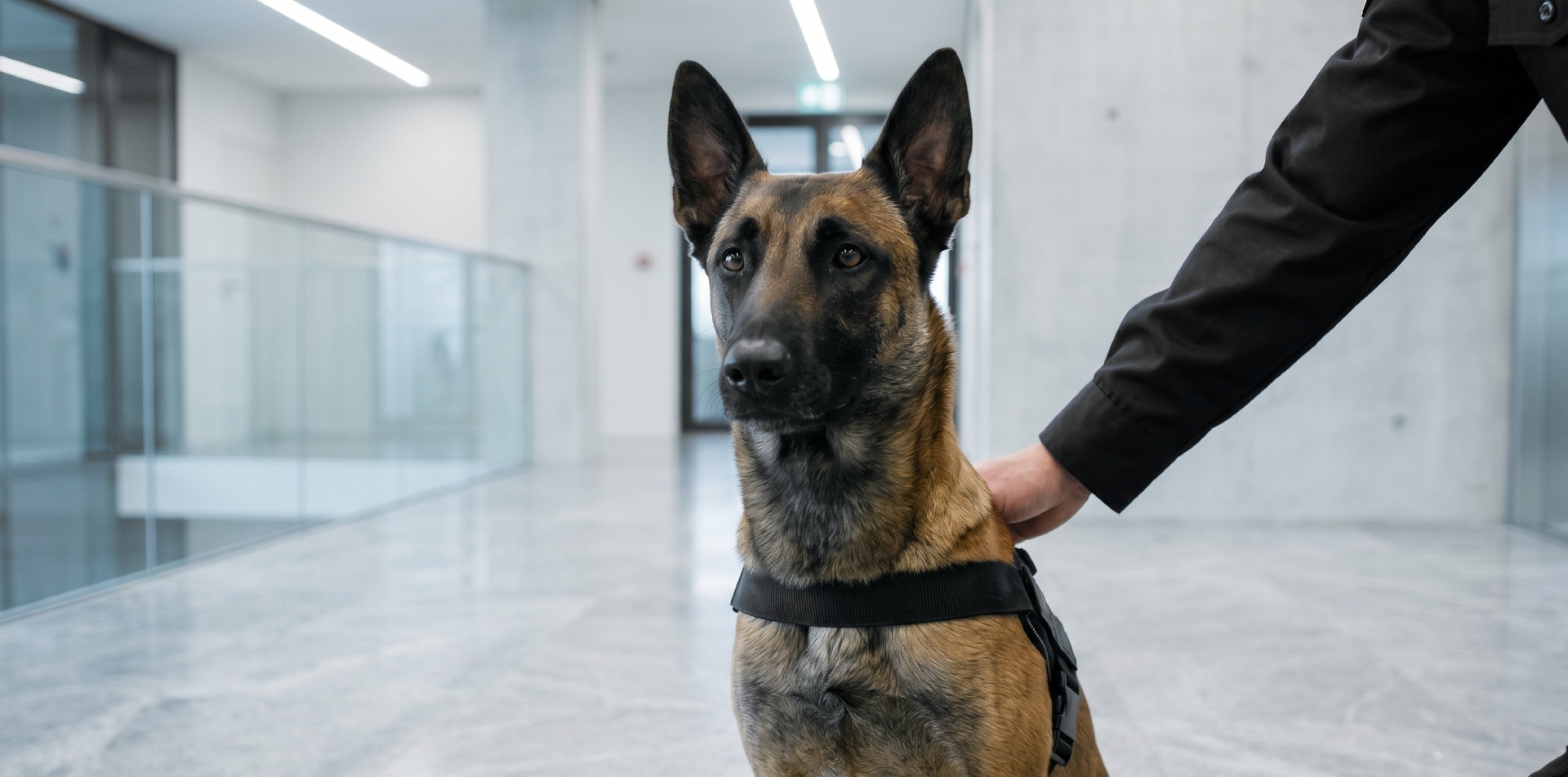
We would like to extend a warm welcome to Sebastian Adam, Kearta Parent, Bonnie Gallant, Stephanie Patrs, Stephen Kelly, and Kayla Watt to our Greater Toronto Area operations!
And a big shout out and good luck to Handler AnneMarie Pare from Québec City, Québec. She is currently in Romania and will be representing Canada at the international Dog event with her personal dog “Jigsaw”. She will be competing against teams from around the world in IGP, (a Triathalon-type K9 event) doing obedience / tracking and protection work.
We wish Anne Marie all the best luck at this prestigious event!
By Laurel Woodhouse, H&S Manager and Vince Gemmiti, Training Manager, RES/CIC
Working in public-facing security roles means you’ll encounter a wide range of behaviours— from confused or upset members of the public to aggressive or unpredictable individuals. Keeping yourself, your colleagues, the public, and clients safe starts with prevention, calm communication, and knowing when to escalate. Use the guidance below during every shift.
Key Principles
Stay aware: scan your area for potential issues (crowds, alcohol/narcotic use, obstructions) and position yourself to maintain visibility and a safe exit.
Stay calm and professional: your tone, posture, and language set the tone of the interaction.
Prioritize safety over being right: de-escalation and containment are primary goals; enforcement and confrontation are secondary.
Communicate and document: notify supervisors/ dispatch early if concerns arise and record the incident afterward.
Verbal Judo — Practical Tips
Use the 3-step approach: Ask, Set Options, Confirm
Ask — politely request cooperation (“Sir, could you step back from the platform edge, please?”).
Set Options — present clear, limited choices that are acceptable to you (“You can wait behind the line, or I can call assistance.”).
Confirm — close the interaction and document the outcome (“Thank you for moving back. I’ll stay nearby until the train arrives.”).
Use calm, directive language: short sentences, low/ moderate tone, non-accusatory words.
Name the behavior, not the person: “I cannot allow this bag on the seat” rather than “You’re being reckless.”
Use empathy statements: “I can see you’re upset. I want to help. Let’s do this together.”
Avoid arguing, sarcasm, or raising your voice.
Safe Distance & Positioning
Maintain a non-threatening distance: usually 1.5–3 meters (6–12 ft) depending on the person’s behavior and environment.
Keep an unobstructed path to an exit; position yourself at a slight angle rather than directly face-to-face.
Use environmental barriers when appropriate (desk, counter, open doors) to preserve space.
If a subject becomes agitated, increase distance and create space for escape—not to retreat from duty, but to reduce risk.
Be prepared to reposition, away from or within the situation depending on your assessment.
When to Call Police or Additional Support
Immediate threat to life, weapons present, or violent assault.
Subject displays clear intent to harm self or others.
Crime is in progress and requires law enforcement (theft in progress, forced entry).
You cannot safely control the situation or the subject becomes physically aggressive.
Persistent refusal to follow lawful safety directives that create imminent risk (e.g., refusing to leave a secure area).
If in doubt and risk is increasing, call dispatch for advice and backup.
Scenario + Do / Don’t Checklist
Scenario: Late evening on a transit platform, an irate passenger shouts at staff after being denied access to a restricted area. He paces aggressively and throws a small item toward the platform edge.
Do:
Keep a safe distance and signal backup immediately
Use a calm, firm voice: “Sir, please step back. I’m calling for assistance.”
Offer limited options: “You may wait behind the line or move to the seating area.”
Use a neutral stance and maintain clear sightlines.
Document the incident and report to your supervisor and dispatch.
Use the relational approach by asking them what you can do to help: “I can see you are struggling…” or “I want to help you, talk to me.”
Use active listening to understand what the problem may be to assist them in finding a solution.
Collaborate with them, give them the power to solve their crisis rather than imposing one upon them.
Don’t:
Approach directly or block his/her exit path.
Match aggression—do not shout or use insults.
Engage in prolonged argument or try to physically restrain unless trained and necessary.
Leave the area without notifying dispatch or a colleague.
Quick Reminders
Report all interactions that escalated or made you feel unsafe, even if no injury occurred.
Refresh de-escalation training every year and participate in scenario drills.
Keep radio/phone charged and accessible; know sitespecific escalation numbers.
By Jashandeep Singh, Assistant Manager, Resource Planning
At the core of our organization lies Resource Planning, a team that keeps everything connected, aligned, and running efficiently. Acting as the backbone of operations, this department collaborates closely with all divisions to ensure the right people are in the right place at the right time.
We’re proud to take a moment to recognize the incredible individuals who drive this function forward every day. Their dedication, teamwork, and commitment to excellence are what keep our operations seamless and successful.
Leading the way is Sean Gallagher, Associate Director of Talent Acquisition and Resource Planning. Sean’s strategic approach to staffing and his continuous support have been instrumental in maintaining optimal workforce levels across the organization. His leadership helps set the foundation for a strong and agile team.
Supporting Sean in overseeing all divisions are Assistant Managers Jashandeep Singh and Jasmeen Chahal. They are committed to delivering essential training and ensuring team readiness. Their responsibilities include maintaining compliance with CBA regulations, Health and Safety standards, labour codes, and staffing and training requirements.
Division Highlights
Aviation Division Led by Jashandeep Singh
Planners Shweta Tomar and Manpreet Grewal work collaboratively to manage daily staffing levels and ensure smooth day-to-day operations.
REC/CIC Division Led by Jasmeen Chahal
Planners Jatin Assija and Sukhwinder Dhillon work closely together to maintain seamless daily operations and provide consistent support to the team. Additionally, Mark Dwulit is assisting with ensure coverage for Rogers Stadium.
K9 Division
Muskaan leads the K9 Division with a focus on clear communication and operational efficiency. She works closely with Supervisors to ensure all essential tasks are completed while consistently meeting client requirements. Supporting her behind the scenes are Jashandeep, and Jasmeen, who provide additional operational backup and guidance when needed, ensuring continuity and strong performance across the division.
Overnight Team
During overnight hours, Charlene Abella and Kishan Amar Ally take on full responsibility across all divisions. Their ability to make effective decisions in real time plays a crucial role in maintaining smooth and uninterrupted operations. Their dedication ensures that the organization continues to perform at a high level—around the clock.
Support Team
Over the past few months, Resource Planning has also benefited from the valuable support of team members from various divisions. Kajal Sharma from the Shift Manager Team at Toronto Pearson Airport has played an integral role in assisting RP with her expertise, knowledge, and Page 5 Security MattersTM Spring 2026 hands-on support. Mark has been invaluable in assisting us with the complex scheduling requirements for Rogers Stadium.
We would also like to extend our sincere appreciation to Anirudh Murali (Respite) and Bindia Dutt (Residential) for their continued support, particularly during challenging times. Their willingness to step in and contribute has made a meaningful difference to the team’s success.
Well Wishes
Our heartiest congratulations to Andrew Catney for his next chapter in his career. Andrew led Resource Planning with passion and hard work for the past four years.
By Humberto Pimentel, President & CEO
Spring is here, and with it comes new energy, new opportunities, and a renewed sense of what this team is capable of. As we look forward to an exciting year ahead, we also want to take a moment to reflect on what we accomplished together in 2025.
Last year brought its share of challenges and change, yet your commitment never wavered. Because of your professionalism, reliability, and teamwork, our customers continuously received the excellent service they expect from us. We are very proud that Rogers Stadium renewed their contract with us, and we successfully mobilized for the Regional Municipality of Halton contract.
To our frontline teams: whether you worked days, nights, weekends, holidays, or stepped in when it mattered most, thank you. Your efforts kept our sites safe, our clients confident, and our reputation strong.
To our supervisors, managers, and support staff: thank you for guiding operations, supporting your teams, and maintaining high standards. Your leadership made the difference.
Because of all of you, we strengthened our operations, continued to grow, and delivered on our promises. We are incredibly proud of what we accomplished together — and we look forward to building an even stronger 2026 with this exceptional team.
Stay safe, and thank you for everything you do.
The modern data center is a marvel of engineering, built to maximize efficiency, data storage, and uptime. Yet, as facilities scale up to meet hyperscale demands, managing physical security through traditional methods alone becomes increasingly challenging and cost-prohibitive.
To combat sophisticated physical threats, data center operators are turning to advanced, AI-enhanced technology to protect their perimeters, premises, and server racks.
At ASP, we believe that optimizing your physical security layout shouldn’t come at the cost of your bottom line. Guided by former AWS technology security leaders, we design tech-integrated security architectures that prove exactly why Security Matters™ in the digital age.
Redefining Asset Protection with the Proprietary Rack Security Device (RSD)
In colocation and enterprise data centers, multi-tenant environments introduce unique internal risks. Traditional cage locks are no longer enough to satisfy strict client demands or compliance audits.
To bridge this gap, ASP developed the proprietary Rack Security Device (RSD). This compact, automated hardware solution is purpose-built to safeguard the most critical data inside IDFs, MDFs, and hyperscale environments. By utilizing only 1U of rack space and a single PoE port, the RSD delivers robust, localized security tracking without eating into your valuable server real estate.
Harnessing AI-Enhanced Technology and Automated Patrols
Scaling a data center footprint usually means increasing the number of physical guard hours—but smart technology is shifting that paradigm. By deploying intelligent automation, facilities can actually increase their security posture while lowering overall program costs.
ASP Automated Patrols: Tailored to your data center’s unique layout, our automated patrol solutions provide persistent, round-the-clock site surveillance. This reduces the staffing burden while ensuring that no corner of your facility is left unmonitored.
Wireless Remote Surveillance: For sprawling hyperscale campuses or remote perimeters, wireless remote cameras fill critical blind spots. Utilizing advanced video analytics, these systems detect anomalies and trigger live audio challenges to deter intruders long before they reach an access point.
Empowering Guards with Connected Operations
Technology is at its best when it empowers human decision-making. Our on-site data center security professionals are backed by a state-of-the-art tech ecosystem:
Security Officer Body-Worn Cameras: Body cameras provide our 24/7 Security Operations Center (SOC) with on-demand streaming and precise location tracking, feeding real-time situational data directly into your preferred security software management system.
Proprietary Security Operations Software: This centralized platform streamlines team performance, incident logging, and risk assessment, ensuring operational resilience across all business-critical layers.
Build a Resilient, Tech-Driven Security Posture
As data centers evolve, your physical security strategies must evolve with them. Relying on outdated systems leaves your mission-critical infrastructure vulnerable to downtime and non-compliance.
Discover how ASP’s suite of proprietary technology and specialized data center guarding can protect your facility. Reach out to our specialized team today for a comprehensive security consultation.
As Canada’s digital economy accelerates, data centers have become the absolute backbone of business continuity. From colocation environments to massive hyperscale campuses, these mission-critical facilities warehouse the world’s most valuable asset: data.
While cybersecurity teams work tirelessly to defend against digital threats, physical security remains the first—and most vital—line of defense. A single physical breach can lead to devastating downtime, data loss, and crippling compliance penalties.
To safeguard Canada’s digital infrastructure from coast to coast, modern facilities require a specialized security partner who understands that in mission-critical environments, Security Matters™.
The Compliance Challenge: Staying Audit-Ready 24/7
Data center operators must adhere to strict regulatory frameworks and federal security requirements, including SOC 2, ISO/IEC 27001, and rigid privacy legislation. Failing an audit or experiencing a security gap isn’t just an operational failure; it’s a reputational disaster.
Achieving continuous audit readiness requires a proactive, layered security approach. At ASP, our data center protection strategies are led by former AWS technology security leaders. We couple this elite technical expertise with the immense operational power of 4,000 security professionals deployed daily across North America. The result? A specialized force that understands data center complexities from day one—meaning no learning curves for your business.
Layered Physical Security: From Perimeter to the Server Rack
True data center security cannot rely on a single checkpoint. It requires multiple, reinforcing rings of protection:
Perimeter Protection with Advanced Analytics: Modern threats move fast. ASP utilizes advanced AI-enhanced video analytics and 24/7 live video monitoring to detect and deter intruders before they touch your outer walls. Coupled with live audio-challenge capabilities and rapid mobile patrols, potential threats are neutralized instantly.
Biometric & Video Access Control: Restricting access to authorized personnel requires industry-leading validation. By combining biometric, digital, and video verification, operators can seamlessly manage movement throughout the facility.
Proprietary Rack-Level Security: Security shouldn’t stop at the server room door. ASP’s proprietary Rack Security Device (RSD) offers an automated, comprehensive solution to protect high-value data within IDFs, MDFs, and colocation cages. Occupying just 1U of space and requiring only a single PoE port, the RSD ensures that your most critical data remains secure and fully monitored.
Incident Response: “Eyes in the Sky, Boots on the Ground”
When an alarm triggers, every second counts toward maintaining maximum uptime protection. An elite security program relies on a flawless loop of communication between data and personnel.
ASP’s Security Operations Centers (SOC) act as the central nervous system, maintaining continuous oversight. If a vulnerability is spotted, our vehicle-bound and foot-patrolling security agents deploy instantly. This synchronized approach ensures that threats are resolved with unparalleled speed and effectiveness.
Partner with Canada’s Trusted Data Center Security Experts
Securing the infrastructure that powers the cloud demands more than general guarding; it requires a tech-integrated, compliance-driven framework tailored to hyperscale and colocation realities.
Don’t leave your uptime or your compliance to chance. Contact ASP Security Services today to schedule a data center security consultation.
In the high-stakes environment of Toronto’s “Class A” commercial real estate, a single lapse in judgment on the front lines can lead to a decade of brand damage. As we move deeper into 2026, the traditional metric for security success—”nothing happened today”—is being replaced by a more complex question: “If something does happen, how will it be handled?”.
For facility managers in the Greater Toronto Area (GTA), the threat landscape has evolved beyond simple property theft. We are now operating in an era of “Cyber-Physical Convergence” and heightened social scrutiny. In this climate, a security provider that relies on “force-first” tactics isn’t just a poor choice—it’s a massive liability to your bottom line.
The Ontario Regulatory Shift: Why Your Reporting Burden Just Got Heavier
In late 2024 and throughout 2025, the Ontario government, via the Ministry of the Solicitor General’s Private Security and Investigative Services Branch (PSISB), introduced sweeping changes to how security incidents are tracked.
New Reporting Mandates
Licensees in Ontario are now mandated to report every single instance of “use of force” to the provincial registrar within thirty days. This isn’t just a paperwork update; it’s a fundamental shift in visibility. Every physical intervention is now a matter of public and provincial record, significantly increasing the legal exposure for property owners who employ poorly trained staff.
The “Policification” of Private Security
With over 162,000 licensed security individuals in Ontario as of 2025, private security is increasingly being forced into roles that mirror public policing. This is especially true in high-traffic retail environments and social-service-integrated transit hubs.
However, unlike public police, private security lacks the same legal “buffer” regarding liability. When a guard makes a mistake, the building owner is often the first entity named in the ensuing litigation.
The Viral PR Nightmare: Guarding Against “Brand Rot”
The “unspoken fear” for a Toronto Property Manager is not just a lawsuit, but a viral video. A “use of force” incident captured on a smartphone can transition from a localized event to a catastrophic PR nightmare in minutes.
The Social Cost of Poor Training
In the current climate, your choice of security vendor can lead to direct tenant protests or public boycotts. This “brand rot” devalues the property’s prestige and can lead to a mass exodus of elite tenants who are currently part of the “flight-to-quality” trend in the Toronto market.
At ASP Security Services, we understand that Security Matters™ because your reputation is on the line. We don’t just train for safety; we train for reputational resilience.
The Science of De-escalation: Moving Beyond Provincial Minimums
The standard 40-hour course required for an Ontario security license is a baseline, not a benchmark. To truly protect a Class A asset in the GTA, your team must possess skills that surpass provincial minimums.
Behavioral Observation Awareness Training (BOAT)
The most effective way to manage a crisis is to ensure it never starts. Our specialists undergo intensive Behavioral Observation Awareness Training.
Pre-Incident Indicators: Specialists learn to identify subtle cues—anomalous body language, specific verbal patterns, or “out of place” loitering—long before a situation turns physical.
Active Crowd Scanning: Instead of staring at a single screen or post, our teams use dynamic situational awareness to map the “mood” of a lobby or transit hub in real-time.
Non-Violent Crisis Intervention (NVCI)
When a situation does escalate, the goal is “de-escalation with dignity”. Our Non-Violent Crisis Intervention training equips staff with the verbal tools to resolve conflicts without resorting to force.
Verbal Judo: Using professional communication to steer an aggressive individual toward a peaceful resolution.
Liability Reduction: By prioritizing de-escalation, we drastically reduce the number of reported “use of force” incidents, keeping your building’s record clean and your brand safe.
Security as a Reputation Safeguard: The Economic Value of Engagement
In 2026, security is no longer a cost center; it is a brand-enhancing asset. A professional security presence that is both welcoming and vigilant increases the perceived value of your property for elite tenants.
The “Personality” Filter
At ASP, we hire for personality and train for the job. We seek out individuals who represent a “customer-centric commitment”—people who understand that they are the face of your building.
Tenant Trust: Consistent, professional engagement builds a rapport with tenants, making them more likely to report suspicious activity early.
Operational Continuity: Highly motivated staff are less prone to the “cellphone usage” or disengagement incidents that plague larger, bureaucratic firms.
Transparent Partnerships: ISO 9001:2015 and the Power of Data
In an era of “Uncertainty and Complexity,” property managers need more than just a promise—they need proof. ASP provides a “Truly Transparent Partnership” through our ISO 9001:2015 certification.
Administrative Excellence
Our certification isn’t just a badge; it’s a commitment to a procedurally driven approach.
Real-Time Digital Reporting: Every patrol, every sweep, and every interaction is logged in a transparent digital portal, giving you an auditable record of your site’s safety.
Continual Improvement: We audit our own performance 1–3 times per year to ensure we are constantly evolving ahead of new threats in the GTA and surrounding areas.
Beating the 42-Minute Gap: The Economics of Immediate Verification
While de-escalation protects your brand, response time protects your continuity. In Toronto, the “Cost of Waiting” is a significant economic risk.
The Verified Response Standard
Because the average police response for a commercial alarm is 42 minutes, the burden of “verification” falls on you. Our rapid response capability—under 45 minutes notice—ensures that an incident is verified and contained before it requires heavy-handed intervention.
Turning Your Security Risk into a Strategic Edge
The Greater Toronto Area in 2026 does not allow for amateur hour. With the World Cup approaching and retail crime becoming more professionalized, the “Standard of Care” for your building has never been higher.
Don’t let your security become your biggest liability. Choose a partner that understands that de-escalation is not just a tactic—it’s a Liability Shield. Because in high-stakes Toronto environments, Security Matters™.
Is your property currently one viral video away from brand rot?
Toronto is currently the fastest-growing city in North America, and in 2026, it becomes the center of the sporting world. The arrival of the 2026 FIFA World Cup™ represents more than just a series of matches from June 12 to July 2; it is a massive urban “pressure test” for our city’s infrastructure, transit hubs, and commercial centers.
For facility managers and operations directors, the question isn’t whether you have guards on-site, but whether your security strategy is resilient enough to handle a global influx of millions while maintaining day-to-day operational continuity. In 2026, the baseline for safety has reached a new height, and generic “static” guarding is no longer a viable defense.
The Pressure Test: Preparing for 2026’s Unprecedented Urban Influx
Toronto’s population growth of 6.6% has already outpaced many frontline public capacities. When the World Cup arrives, this density will explode. Planners are bracing for peak staffing shortages and potential “absolute disasters” regarding transit delays.
The “unspoken fear” for property managers in the downtown core is the Response Gap. When millions of people are navigating the Financial District, local police resources are understandably prioritized for high-level Priority 1 emergencies.
The 42-Minute Problem: Currently, the average police response for a commercial alarm in Toronto is 42 minutes.
The Latency Trap: During a massive global event, lower-priority calls (Priority 3 and 4) can wait between 57 and 89 minutes.
A commercial center cannot afford to wait an hour for security verification during a global event. ASP Security Services provides the 45-Minute Standard, with the proven capability to respond to emergency situations with less than 45 minutes’ notice. This rapid mobilization is the only way to ensure that a localized disruption doesn’t cascade into a multi-million dollar economic loss.
Transit Under Fire: Securing Union Station and Pearson International (YYZ)
Transportation hubs serve as the primary gateways for the 2026 World Cup, making them the most vulnerable points in the city’s infrastructure. Union Station and Toronto Pearson (YYZ) are already undergoing intense revitalization and regulatory tightening to prepare for this shift.
The Aviation-Grade Standard
As a subsidiary of ICTS Europe, ASP brings an “Aviation-Grade” discipline to commercial security that legacy firms simply cannot match. This standard is critical for the Enhanced Non-Passenger Screening (NPS) mandates introduced by Transport Canada in 2025.
100% Screening Rates: Security checkpoints at major hubs now require 100% screening for vehicles and occupants to mitigate internal threats.
Operational Readiness: ASP performs rigorous “Stress Tests” to ensure that checkpoints can handle high-volume bottlenecks without compromising safety.
Community Safety Ambassadors
At Union Station, the traditional guard has been replaced by the Community Safety Ambassador (CSA). These specialists often hold degrees in social services or justice studies, serving as a vital link between the public and emergency services. Their role isn’t just “enforcement”—it’s building relationships and de-escalating conflict in a high-pressure urban environment.
The Biological Fail-Safe: Why Canine EDD is the Critical Defense for 2026
In the “Software Eating the World” era of 2026, we have seen a massive shift toward AI-driven monitoring. However, for clearing a densely populated event venue or an air cargo terminal, nothing matches the biological perfection of a Canine Explosive Detection (EDD) team.
ASP is the largest private Canine EDD provider in Canada. Our partnership with global entities like DiagNose provides a pool of over 200 certified dogs worldwide.
Scent Decoding: A trained canine can identify trace elements of explosives and firearms almost immediately, even when masked by complex odors or hidden in bulk cargo.
Mobility: Unlike static sensors, a K9 team can sweep a Class A lobby or a stadium seating area in a fraction of the time, providing “eyewitness” verification that satisfies the Toronto Police Verified Response Protocol.
FIFA Ready: We have been preparing the “FIFA Generation” of detection dogs specifically for the 2026 World Cup, ensuring that every high-profile event venue in the GTA has access to a certified defense.
Behavioral Detection over Enforcement: The “Ambassador” at the Gates
One of the top anxieties for Toronto decision-makers is the risk of a “use of force” incident going viral during a global event. In 2026, the private security force acts as the critical buffer between the public and enforcement agencies.
The ASP Ambassador Model elevates the role from a reactive guard to a proactive specialist. This is achieved through a sophisticated 4-Stage Engagement Process:
Active Crowd Scanning: Moving beyond static monitoring to dynamic situational awareness.
Engagement: Proactive, friendly interactions that humanize the security presence.
Casual Conversation: Utilizing behavioral observation to identify potential threats while maintaining a premium customer experience.
Course of Action: Rapid, informed decision-making based on proactive assessment.
By hiring for personality and training for the job, ASP ensures that its specialists “select the high road” even under the intense pressure of a global tournament.
Resilience and Reputation: Why Strategic Planning is Non-Negotiable
In 2026, “Resilience” has evolved from a sustainability goal into a core business imperative. For a Class A property, security is a brand asset that protects property value and tenant trust.
Transparency and Certification
ASP is ISO 9001:2015 certified for administrative functions related to uniformed security guards. This ensures a “Truly Transparent Partnership” where clients have real-time access to incident reports and performance audits. In an era of “Uncertainty and Complexity,” this level of procedural discipline is what differentiates a “trophy property” from a commodity building.
Cyber-Physical Convergence
Modern buildings are “smart” ecosystems. The 2026 threat landscape involves “cyber-physical” breaches where digital exploits lead to physical paralysis. ASP addresses this by integrating cloud-based reporting and AI-driven monitoring into the human-centric patrol, ensuring there are no “technological blind spots”.
Security Matters™ Because Your Brand is on the Line
The 2026 FIFA World Cup™ is more than a game; it is a moment for Toronto to shine on the world stage. But for those responsible for the city’s commercial and transit infrastructure, it is a mission.
You cannot navigate the risks of 2026 with the security model of the past. You need the Ambassador model. You need Canine EDD. You need a partner that understands that in high-stakes environments, Security Matters™.
Is your facility truly resilient for the 2026 spotlight?
As we wrap up another busy holiday season, we want to take a moment to recognize the incredible individuals who make our team what it is. Over the past few weeks, we have seen dedication, teamwork, and generosity consistently demonstrated — and it has truly not gone unnoticed.
To everyone who joined our holiday gatherings, thank you for bringing positivity and connection to our celebrations. These moments remind us that we are more than colleagues — we are a supportive and united team.
A special thank you to those who worked through Christmas and New Year’s. Being on duty during the holidays requires personal sacrifice, and your commitment ensured that our operations continued smoothly and professionally. Your reliability and strong work ethic reflect the true strength of our organization.
As we move into the new year, we do so with appreciation and confidence. Thank you for your hard work, professionalism, and the positive attitude you bring each day. Together, we will continue building a workplace grounded in respect, teamwork, and excellence.
Here’s to a successful and rewarding year ahead.
By Noman Butt, Operations Manager YYZ
I would like to congratulate our Specialist, Nimal Antony, on receiving recognition from ASP and the Greater Toronto Airports Authority. Please see the client’s comments below:
“I am writing to formally recognize Behavioral Specialist, Nimal Antony, for his exceptional professionalism, patience, and composure while handling two recent challenging instances while on duty.
During a recent incident involving an intoxicated male subject suspected to be under the influence of narcotics, Nimal demonstrated outstanding situational awareness and calm decision-making. He effectively maintained control of the situation, ensured public safety, and coordinated with SOC, PRP, CBSA, and Paramedic services until the individual received appropriate medical care. Despite challenging conditions, his actions reflected strong judgment, professionalism, and adherence to protocol, resulting in a safe resolution.
His ability to manage high-stress situations while keeping his composure sets an excellent example for his colleagues and reflects positively on ASP as a whole. Please extend our sincere thanks and congratulations to Nimal, on behalf of the GTAA Safety and Security Team, for his excellent service.”
Nimal, thank you for your professionalism, leadership, and commitment to safety. You have represented our team exceptionally well, and we are proud of your outstanding work.